
The Real Problem With Moving Money Today Isn’t Speed, It’s Trust
We’ve solved the speed problem.
Today, you can send money across countries in minutes. Payments are faster, platforms are more accessible, and moving money is no longer the slow, frustrating process it used to be.
But even with all this progress, one thing still feels uncertain.
You can send money quickly, but you’re not always sure what happens next.
Will the other person follow through?
Will you actually get the value you agreed on?
Is your money really secure in the process?
That uncertainty is what people are starting to pay attention to.
Because in today’s financial world, the real issue isn’t how fast money moves, it’s how much you can trust the process behind it.
More people are starting to pay attention to the small gaps in these transactions. The difference between the rate you expect and the one you actually get. The quiet deductions that aren’t always obvious. The delays that don’t always make sense.
Individually, these things seem minor. But over time, they start to feel like a pattern.
And once people notice that pattern, they begin to ask a different kind of question, not “how do I send money?” but “how do I do this better?”
That question is what’s driving a shift across the financial world.
Instead of relying entirely on institutions, people are beginning to explore more direct ways of transacting. The idea is simple: if two people can agree on a transaction, why shouldn’t they be able to complete it on their own terms?
This is where peer-to-peer finance starts to make sense.
It gives people room to decide. To agree on rates. To move faster. To feel like they’re part of the transaction, not just passing through a system.
But with that freedom comes something else: Hesitation.
Because while direct transactions sound efficient, they also raise a very real concern: trust.
It’s one thing to send money through a system you don’t fully understand. It’s another thing entirely to send it directly to someone you don’t know.
That uncertainty is what has held many people back.
And honestly, it should.
Because in finance, flexibility without protection isn’t progress, it’s risk.
This is why the conversation is no longer just about speed or cost. It’s about structure. About how to create a system where people can have both control and security at the same time.
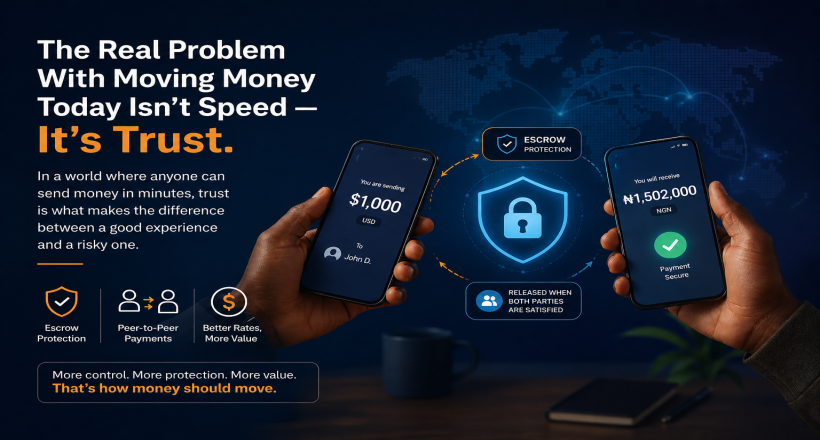
That’s where escrow has quietly become one of the most important pieces of modern transactions.
Instead of relying on trust alone, escrow introduces a simple idea: no one loses.
Funds are held in a neutral space, not controlled by either party, and only released when the agreed terms are fulfilled. It removes the need to “hope” things go right and replaces it with a system that ensures they do.
And that shift, from trust-based transactions to system-backed trust is a big deal.
Globally, conversations around financial systems are starting to reflect this. Institutions like the World Bank continue to emphasize the importance of transparency and trust as digital transactions become more common.
Because at the end of the day, the biggest risk in finance isn’t always volatility.
It’s uncertainty.
People want to know that when they send money, it will get where it’s supposed to go. That when they agree on a rate, they’ll actually receive it. That they’re not quietly losing value somewhere along the process.
And that’s exactly why platforms built around this new way of thinking are gaining attention.
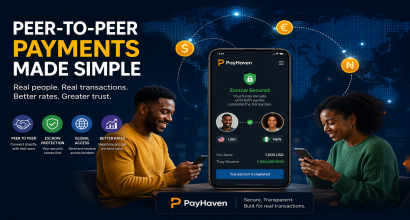
PayHaven, for example, operates within this shift. It doesn’t try to replace the idea of transactions, it improves how they happen. By allowing users to interact directly, agree on terms, and still have their funds protected through an escrow system, it removes the tension that usually comes with peer-to-peer exchanges.
You’re not forced to choose between control and security.
You get both.
And in a financial environment where every decision affects value, that balance matters more than ever.
Because the future of money isn’t just about moving it faster.
It’s about moving it with clarity, with confidence, and without unnecessary loss.
And for a lot of people, that change is already long overdue.